In 1996, I graduated with a Master of Fine Art (MFA). My final degree project took the form of a public monument conceived as a reflection on infinity.
I collaborated with the municipality of Ylämaa in southeastern Finland, a region known for its strong concentration of Baltic brown granite, Baltic green granite, and the gemstone spectrolite. The municipality invited me to create a monument using Baltic brown granite and granted me full artistic freedom, as did the university.
I was drawn to the idea of infinity as it appears in prehistoric megalithic monuments across Europe—structures that articulate continuity, repetition, and duration beyond the human lifespan.
The work was realized using Baltic brown granite, Terijoensalava (Salix fragilis ‘Bullata’), a tree native to Ylämaa, and the technical resources provided by the municipality.
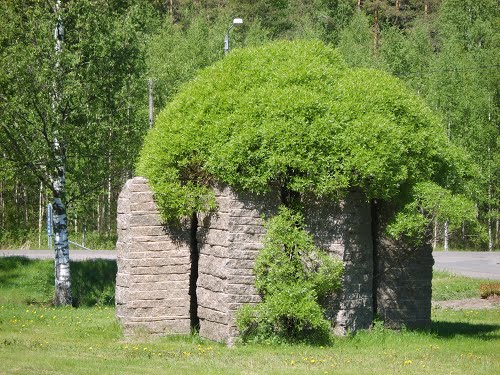
The monument brings together stone and living matter as parallel carriers of time. The Baltic brown granite, formed over geological time, represents duration, weight, and resistance to change. In contrast, Terijoensalava (Salix fragilis ‘Bullata’), a tree native to Ylämaa, embodies growth, decay, and regeneration.
Through its ability to send out root shoots that may develop into new trees, the tree continues to exist beyond the lifespan of a single trunk. In this way, the work stages two different temporalities: geological permanence and biological continuity.
Through erosion, weathering, and organic growth, time becomes a co-author of the monument, allowing it to change while remaining.


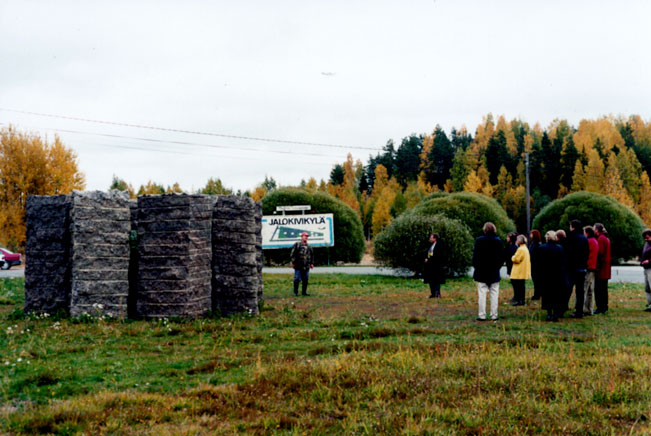

As reported in a local Finnish newspaper